Friday, November 27, 2020

The importance of washing our hands

At the beginning of the Covid-19 pandemic, before we went into lockdown, we decided to try to explain to the children how easily germs can spread. Just because you can't see them, doesn't mean they aren't there.

To show the importance of thorough hand washing, we did a little experiment.

Here's what you need:
  • bread
  • hand sanitiser
  • handwashing liquid
  • water
  • various communal classroom items (e.g. ipad, pencils, etc)
  • gloves
  • sealing sandwich bags
Here's what we did:
  1. Teachers handed the bread with gloves.
  2. One student washed their hands well for 20 seconds, following the display posters. They then wiped their hands on a piece of bread and it was placed in a labelled sandwich bag.
  3. One student used hand sanitiser and then wiped their hands on a piece of bread.
  4. One student did not wash their hands at all and wiped their hands on a piece of bread.
  5. Then we wiped a piece of bread on an iPad and whiteboard pens.
  6. We left the sandwich bags for two weeks and then looked at the results.
I only got a picture of the pieces of bread that grew nasties but it proved our point and was certainly a conversation starter!

Have you conducted any experiments to show the importance of hand washing?

Tuesday, November 17, 2020

Arctic Adventures

When Winter hit, it was only appropriate to start a chilly theme like Arctic Adventures.


I enjoyed the classroom decorations for this theme. I even bought a sneaky pair of cute classroom slippers to wear, when appropriate of course.


Monday, November 16, 2020

Castles and Crowns

We moved from Africa onto Castles and Crowns in our second term together. I didn't get many photos of the setup but I did manage to find a photo of the role play area with a little banquet table and dress ups.


My favourite part of this unit was most definitely our school trip to Windsor Castle. My teaching partner and I put together a letter from 'Windsor Castle' inviting the children to enter a competition to 'win a trip' to the castle. Now, we knew we would going on the trip regardless but they didn't and you should have heard the screams of joy when we 'received' the letter below telling us we had 'won'.


It was such a beautiful place to visit. We got to walk through the state apartments and see the grand rooms all set up. The children were in awe and it is by far one of the coolest trips I have been on with a class.


Sunday, November 15, 2020

A trip to the zoo

With our term theme being 'Africa' we organised a trip to London Zoo to see what other animals might live in Africa. There was a section called 'Into Africa' which was perfect for our learning!

Here are some of the snaps I took on the day:


What are some of your favourite school trips?

Saturday, November 14, 2020

How to make animal 'poo'

The investigations into finding out if our visitor was a monkey or ape lead to different animal types and carnivores, herbivores and omnivores. My amazing teaching partner thought of a fun activity where the children would have to investigate different animals 'poos' to determine which type of animal they were. They then had to record what they found and why they predicted that animal may have been a carnivore, herbivore or omnivore. It was one of the best activities we did the entire year and the children had a blast.


It was super easy to put together. All you need is:
flour
oil
salt
cocoa powder
cream of tartar
hot water
small plastic bugs/insects
leaves
raisins

You simply combine all the ingredients like you would for playdough and then roll pieces in to 'poos'. After, add the different items that hint the animal may have been a carnivore, herbivore or omnivore. Of course, this isn't actually what their poos would look like but it served the purpose of teaching the children about the different animal types and was a great discussion starter.

Let me know if you try this investigation in your classroom.

Friday, November 13, 2020

Teaching in the UK

Well it has been a minute, hasn't it? Almost 3 years actually. I took a leap back in 2018 and moved my life over to the UK to teach for 2 years. It was an amazing adventure and one I will never forget.

I had the privilege of working at two primary schools in England - one in London and one about 2 hours north of London. I had two very different experiences but learnt a lot from both. I'm going to make a few posts here about some things I did in the classroom.

In the UK their school year begins in September and goes through to July and they have 3 school terms throughout the year. My favourite part was the half term break. Every 6ish weeks everyone would get a 1 week break. Then at full terms we would get 2 weeks off. It broke the terms up and everyone appreciated it! I'm not sure how I'll go getting used to 9-13 weeks straight now that I'm back in Australia.

My first full term we had an African theme and all our learning was centred around this. We created our learning space to reflect the theme and to engage the children from the first day they stepped into the classroom.


As our 'stunning start' the children walked into the classroom to discover a cheeky monkey had broken in and would not climb down from the hanging wires.

The children had to find a way to convince the monkey to come down so that we could learn more about him and where he came from.


Some tried to coax him down with bananas and others thought he may be stuck so attempted to build ladders to help him down.

'Please monkey come down or I'll give you 1 banana.'

Eventually he climbed down and told us he was from Africa, lost and missed his family very much. We had to investigate monkeys and apes to find out what he was and help him get home.

Sunday, January 14, 2018

Graduate Teacher Tips Series: 3. Classroom Setup


 I feel the need to put a disclaimer about these posts: there is no one right way of doing things. I am in no way suggesting that this is what every teacher should do in their classrooms. This is for multiple reasons! Every school is different. Every teacher is different. Every classroom is different. Every student is different. All of these will influence how you need to set up your classroom.

The purpose of these posts is to promote ideas for what teachers can or may like to use in their classrooms. With that being said, here is some food for thought regarding classroom setup...

Once you get a look at the shape of your classroom (and boy are there some interesting shaped rooms out there) and what furniture you have, try to sketch out a mud map of how you'd like your room to look.
This image is from the text Handbook for Qualities of Effective Teachers.

When coming up with your mud map, you need to consider how your students will be seated. Today some classrooms use flexible seating. If you choose to adopt this strategy, you will need to carefully plan out where your seating options will be around your classroom. If your room will include student tables or desks, this is also something that needs to be thought out very carefully.

Can we access emergency exits?
Do my students need to be facing a whiteboard?
(In the early years of schooling, this is very important for developing left-to-right direction for handwriting and letter formation)
 Can students and teachers easily move between tables/seating areas?
Will the sun be hitting the desks and cause distractions?

There are endless factors to consider.
All you need to do is Google 'Classroom setup ideas' and thousands of photos of classrooms all around the world pop up. Below are some links to some possible desk arrangements:

My Favorite Desk Arrangement and other Back to School Wisdom, Ideas for getting you school off on the right foot

11 Desk Arrangements for your Best Classroom Yet

For the older classrooms, 'Teacher, Teacher, I declare!' uses the following system with sticky notes:
http://teacherteacherideclare.blogspot.com.au/2013/01/seating-chart-possibilities.html?m=1
 
 Below is a great read about setting up a classroom for students with ADD/ADHD
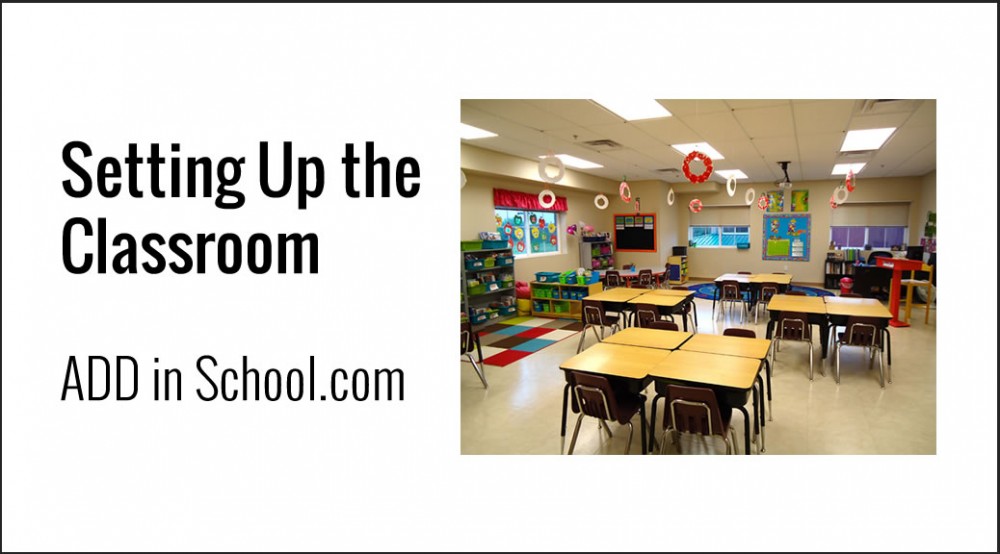
ADHD in School: Room Set up
Some classrooms will be a part of a large building and may not have many windows to consider. Others may feel like fish bowls, for every passing person to gaze in.
Different schools may have certain expectations or rules around windows. For example, some schools allow teachers to paint their windows to stop little ones being distracted from outside factors. On the other hand, there are schools that do not allow anything to be covering windows at all. Make sure you seek advice from your school administration before deciding what you're going to do.
 
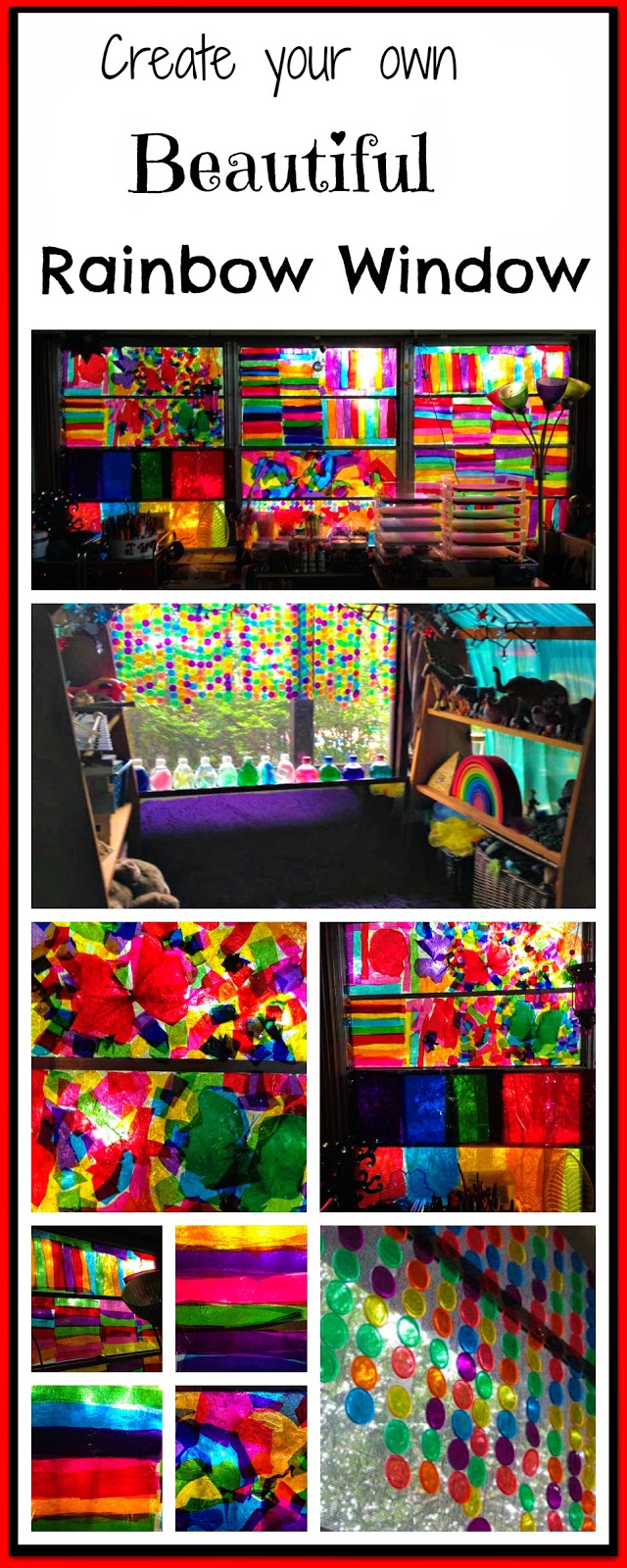
If you choose to go down the cover-up road, here are some ideas from other teachers:

A beautiful 'stained glass' inspired display by Art with Mrs J.
The Charming Classroom made this simple ocean theme window covering.
Reggio inspired rainbow window that casts color around the room
Epic Classroom has some great ideas for rainbow windows.
Something I've learnt over my teaching career so far is that a lot of the time 'less is more'.
Yes, it is exciting to find beautiful posters that fit exactly with what you are teaching. However, they do not need to all be on display at once from the very beginning of the year.

My displays are now these (keep in mind I am in an early years classroom):
 
Alphabet charts
Number charts
Birthday display
Handwriting charts
Visual timetable
Classroom rules
 
Yep. That's it. That is all that goes up on my classroom walls from Day 1 and stays the entire year. Almost everything else only goes up when I teach it. This makes the posters or charts more meaningful to the children. When I teach letters and sounds, we create the posters together and then hang them for future reference. When I teach reading strategies, we introduce a strategy at a time and then hang that poster up - one at a time. Otherwise it is information overload for the little ones and has little meaning to some.
Like I said, just some food for thought 😀

Here are my go-to student labels for an early-years classroom:

Name tags
(for Kinder/Prep/Foundation/Reception and sometimes Year 1/First grade)
Desk plates
(above Prep)
Tidy Tray labels
 (for extra school equipment, if this is how your school sorts these things)
Class names window display
(fitting with theme)
Bag rack labels
(for the younger ones)

Some teachers like to prep name labels for classroom jobs or behaviour charts, too. Again, not every teacher will want or need these.
Last, but most definitely not least, please, please, please prioritise your 'to-do' lists!
 
If you're anything like me, you think of things you want done for your classroom, write them down on your lists and then have this overwhelming urge to get absolutely everything on that list done immediately.
 
Real talk: you don't need to and you will end up draining yourself of energy!
 
 Don't worry about what you see others doing for their classrooms on social media. Prepare what you need to get done first and then work on that 'to-do' list.
For example, those awesome addition games can wait to be made/purchased. They don't need to be done for Day 1.
Your Week 1 plan? YES! Do that! That is a high priority!

Something I learnt from my wonderful father is to write my list of everything I want to get done and then number them in priority of what needs to be done first. This keeps me on track and stops me from doing things that I want to do before things I need to do.

I'd love to hear how some of you are going with your preparations!

Sunday, January 7, 2018

Graduate Teacher Tips Series: 2. Classroom Essentials!

When I entered the classroom for the first time as a graduate teacher, I had no idea what necessities I should have in my room. Today social media has made it so much easier to know what others have in their rooms to guide graduates. BUT it can also be a lot of pressure to see established teachers with all of their years of resources piled high and ready to go.
 
Don't forget, every school has some resources (books, games, etc). Yes, some more than others. You don't need to have every...single...thing printed, laminated and ready to go for Day 1 (this is something I still have to keep reminding myself).

SO if you are heading into your very own classroom for the first time, some of my teacher friends and I have put together a list of some things that every classroom should have and we can't teach without.

Thanks to my friends for contributing:
From the PondClassroom PonderingsLittle Bookish TeacherTeachable Moments Creations

Whether you are heading in for those first few days to start setting up your room at the start of the year or you pick up a contract after school has started, the following are absolute MUSTS. Believe me, you will need them and if you're in the primary years then you will need them daily! Make sure you set aside a designated area for the following, out of reach of little hands.

Liquid or foam pump soap (this is for you AND the students!)
Dishwashing liquid
Chux, sponges or microfibre cloths
Hand towels (lots)
Dustpan & brush
Baby wipes (yep, you'd be amazed at how handy these are)
 Old sheets/towels for messy projects
Spare plastic bags
These are essentials for general classroom organisation for primary:


Good quality Sharpies
Laundry marker
Easel pad/butcher's paper (giant writing material)
Stickers
Stamps
Bell (or something to get the students' attention)
Whiteboard markers/chalk
Rolls of clear contact adhesive
Safety pins
A 'finished work' tray
Teacher letterbox/tray (for students to put permission slips or notes)
5-10 great picture books to start off
Welcome poster
Stop watch & Timer 
Pegs
Multiple printed class rolls
Visual timetable
Velcro dots
Stapler/staple gun
Blu tack
The last list is all about you! Those first few years of teaching are pretty full on - stressful but so exciting! It is important to remember to look after yourself, too. Preparing these few things will help you when you're too busy to remember!


Panadol
Spare water bottle
Pressed powder
Lip balm or lip stick
Mirror
Coffee, tea bags & cup
Raincoat or umbrella
Hair bands
Brush
Peppermints
Chocolate/Snack stash
Warm jacket (to leave in the room)
Ballet flats
Spare coins (for emergency coffee)
Deodorant
A spare phone charger

Click the image below to get a printable copy!

https://www.teacherspayteachers.com/Product/Classroom-Essentials-List-3575100